Uncategorized
Types of Ketamine: Different Forms and Their Uses

Jul
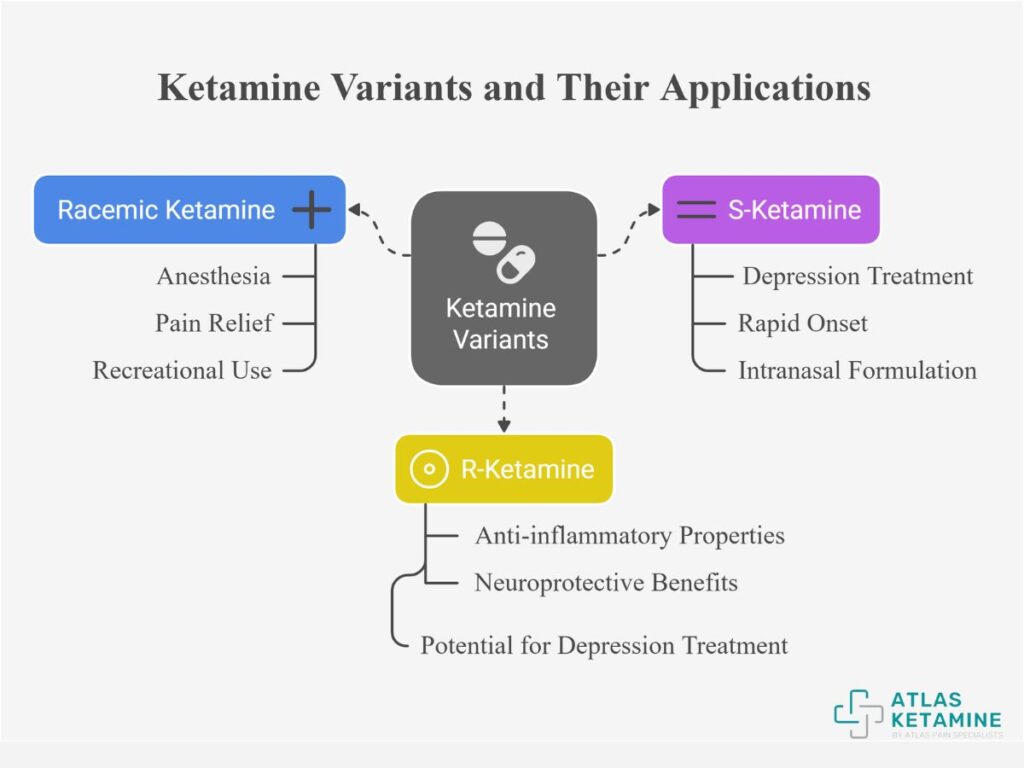
Ketamine, a versatile NMDA receptor antagonist, is available in various forms with distinct uses. Racemic Ketamine (R,S-Ketamine) is a 50-50 mixture of R-ketamine and S-ketamine, commonly used as an anesthetic. S-Ketamine is used intranasally for depression treatment.
Other forms include Esketamine (nasal spray for depression), Intravenous (IV), Intramuscular (IM), Oral, and Subcutaneous administrations, each offering unique benefits and applications in medical and therapeutic settings.
Types of Ketamine
Ketamine is a dissociative anesthetic with various medical and potential therapeutic applications. It exists in different forms, each with unique properties and effects. The three primary types are racemic ketamine, S-ketamine, and R-ketamine. These forms differ in their composition, uses, and characteristics, making them suitable for different medical and research purposes.
Racemic Ketamine (R,S-Ketamine)
Racemic ketamine is a [50/50 mixture] of R(+) and S(-) ketamine. This combination balances the effects of both enantiomers, making it the most commonly used form of ketamine in clinical and anesthetic settings.
Uses:
Racemic ketamine is widely used for [anesthesia] and [pain relief]. Due to its dissociative properties, it is effective in emergency medicine, battlefield medicine, and surgeries where rapid sedation is required. It is also used in sub-anesthetic doses for chronic pain management and as an adjunct to opioid therapy, reducing the need for high opioid doses.
Beyond medical applications, racemic ketamine has been used recreationally due to its hallucinogenic and dissociative effects. However, its misuse raises concerns about dependency and cognitive impairment.
Forms:
Racemic ketamine is available in multiple [forms], including intravenous (IV), intramuscular (IM), oral, nasal, sublingual, rectal, and subcutaneous injections. The method of administration determines the onset and duration of effects, with IV providing the fastest and most controlled results, while oral and nasal forms offer more convenience but may have variable bioavailability.
S-Ketamine (Esketamine)
S-ketamine consists of [pure S(-) ketamine], making it more potent than its R-enantiomer. It has a higher affinity for NMDA receptors, which are involved in pain modulation and mood regulation.
Uses:
S-ketamine is primarily used in intranasal formulations for depression treatment. Approved by the FDA as a nasal spray (Spravato), it has shown rapid antidepressant effects in treatment-resistant depression (TRD). Unlike traditional antidepressants, which may take weeks to work, esketamine provides relief within hours to days.
Characteristics:
S-ketamine has a [shorter duration of action] and a [rapid onset], making it ideal for acute treatments. Its antidepressant effects are believed to stem from its ability to promote synaptic plasticity and enhance neural connectivity in the brain. However, due to its potential for dissociation and abuse, it is administered under medical supervision in a clinical setting.
R-Ketamine
R-ketamine consists of [pure R(+) ketamine]. Unlike S-ketamine, it has a lower affinity for NMDA receptors but exhibits unique pharmacological properties that make it a promising candidate for novel therapeutic applications.
Uses:
R-ketamine is being investigated for its anti-inflammatory properties and potential [therapeutic applications. Studies suggest that it may offer antidepressant effects similar to or even better than S-ketamine, with fewer dissociative and hallucinogenic side effects. R-ketamine has been explored for its neuroprotective benefits and its potential role in treating neurodegenerative disorders.
While research is still ongoing, R-ketamine’s distinct profile could make it a safer and more effective alternative for treating depression, inflammation, and chronic pain without the drawbacks associated with racemic and S-ketamine.
Characteristics:
R-ketamine has a longer duration of action]compared to S-ketamine and may produce antidepressant effects with fewer dissociative and hallucinogenic side effects. It also shows greater neuroplasticity enhancement, suggesting potential benefits in treating conditions like depression and neurodegenerative disorders.
Some studies indicate that R-ketamine provides [sustained antidepressant effects] with a lower risk of abuse and dependency. Additionally, its [anti-inflammatory properties] make it a promising candidate for treating chronic inflammatory conditions.
Forms of Ketamine Administration
Ketamine can be administered in multiple ways, each with unique characteristics that influence its effectiveness, duration, and safety. The choice of administration method depends on the intended use, whether for anesthesia, pain management, or psychiatric treatment.
